
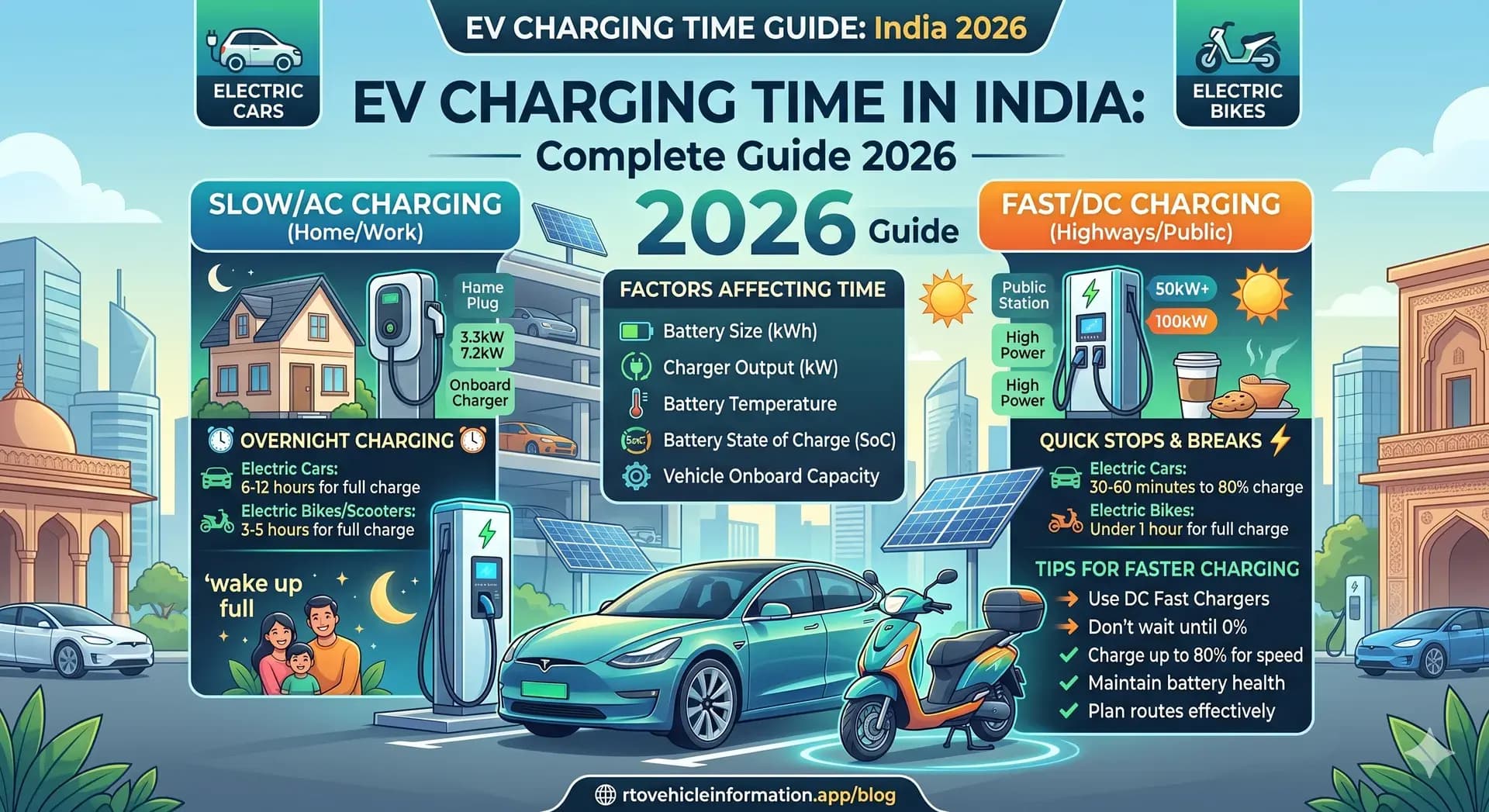
Electric Vehicles2026 guide
EV Charging Time in India (2026)Complete Guide for Cars, Bikes & Charging Types
R
April 16, 2026•11 min read
Electric vehicles are rapidly growing in India, but one concern still holds many buyers back: "How long does it actually take to charge an EV?"
Unlike petrol or diesel vehicles that refuel in minutes, EVs require charging time—but that does not mean inconvenience. With proper understanding, EV charging easily fits into daily routines.
This complete guide explains EV charging time for cars and bikes, charger types, real-world scenarios, and tips to reduce charging time.
EV charging time refers to the time required to recharge an electric vehicle battery from a certain percentage (e.g., 10%) to full (100%) or usable level (80%).
In real-world usage, most EV owners don't charge from 0% to 100% daily. Instead, they top up regularly—just like charging a smartphone.
Charging time is not fixed. It depends on multiple real-world factors:
For example, a small electric scooter may charge in 4 hours, while a large electric SUV could take 10+ hours on a slow charger.
Power Output: 3.3 kW – 7.4 kW
Charging Time: 6 to 12 hours
Best For: Daily use, overnight charging
This is the most practical method for EV owners in India. You simply plug in your vehicle at night and wake up to a fully charged battery.
For daily users, this eliminates dependency on public infrastructure.
Explore public infrastructure: EV charging stations guide.
Power Output: 15 kW – 50 kW
Charging Time: 1 to 4 hours
Best For: City use, quick top-ups
Fast chargers are commonly installed in malls, offices, and city charging hubs. They significantly reduce charging time compared to home charging.
Power Output: 50 kW – 150+ kW
Charging Time: 30–60 minutes (0–80%)
Best For: Highway travel
Rapid charging is ideal for long-distance travel. Most EV users charge up to 80% quickly, as charging slows down after that.
Here are realistic charging estimates for popular EVs:
| Car | Battery | Home Charging | Fast Charging |
|---|---|---|---|
| Tata Nexon EV | 30–40 kWh | 8–10 hrs | 60–90 mins |
| MG ZS EV | 50 kWh | 10–12 hrs | ~60 mins |
| Tata Tiago EV | 19–24 kWh | 6–8 hrs | ~1 hr |
| Mahindra XUV400 | 34–40 kWh | 8–11 hrs | ~50 mins |
👉 Important: Fast charging usually gives 0–80%, not full charge.
Electric two-wheelers charge faster because of smaller batteries:
| Vehicle | Battery Size | Charging Time |
|---|---|---|
| Electric Scooter | 2–4 kWh | 3–5 hours |
| Electric Bike | 3–5 kWh | 4–6 hours |
Most users simply charge overnight or during office hours.
Daily City Usage
Office Charging
Highway Travel
1. Battery Capacity (kWh)
Larger batteries take more time but offer more range.
2. State of Charge
Charging from:
20% → 80% = Fast
80% → 100% = Slow
3. Charger Efficiency
Not all chargers deliver full power due to losses.
4. Temperature
Extreme heat or cold reduces charging speed.
5. Battery Health
Older batteries may charge slower.
Understand long-term battery performance: EV battery replacement guide.
| Feature | EV | Petrol |
|---|---|---|
| Time | 30 min – 10 hrs | 5 min |
| Cost | Very low | High |
| Convenience | Home charging | Fuel station visit |
While petrol is faster, EVs offer greater flexibility and lower long-term cost.
Here are practical tips:
For most users, the answer is No.
Why?
Explore all major EV benefits: EV benefits guide.
India is rapidly improving EV infrastructure:
Check EV subsidies: EV subsidy in India.
EV charging time may seem like a limitation at first, but in reality:
It becomes part of your routine
Overnight charging solves most problems
Fast charging supports long trips
Once you adapt, EV charging feels as simple as charging your phone.
Explore more from the electric vehicle ecosystem:
6–12 hours with a home charger, 30–90 minutes with a fast charger (up to 80%).
Yes, daily charging is normal and recommended.
Yes, but frequent use may slightly affect long-term battery health.
Overnight or during off-peak electricity hours.
Yes, but overall cost is still much lower than petrol.